Eric Joseph Lee, AI Enablement and Automation
I find where AI actually changes the work, build it, and make sure it sticks.
I embed with teams, map how the work really happens, and build the automations and AI agents that remove the manual drag. Then I measure the result and hand it over so the team can run it themselves.
Most work starts with a free one to two hour session mapping how your team really works. Booking is by email.
It starts with a free one to two hour sitdown
Before anyone talks about tools, we map how the work actually gets done. One focused session is usually enough to surface a long list of places where automation or AI assistance would give your team real time back.
- 1
Walk the work end to end
Where requests come in, who touches them, and what gets copied, chased, or typed twice along the way.
- 2
Mark every point of friction
Handoffs, waiting, the same question answered for the tenth time, data moved by hand between tools.
- 3
Sort what we find
Each item gets a label: automate it, give someone AI assistance, or leave it with a person on purpose.
Stage 1
Request comes in
- Automate
Copy form answers into the CRM
- AI assist
Answer the same first questions
- Automate
Stage 2
Triage
- Automate
Route to the right person
- Keep with a person
Decide if it's a good fit
- Automate
Stage 3
Do the work
- AI assist
Draft notes and summaries
- Automate
Chase missing information
- AI assist
Stage 4
Follow up
- Automate
Send reminders with context
- Keep with a person
Hard conversations
- Automate
Why most AI projects stall
The technology usually works. The project fails somewhere else, before the first line of anything gets built.
They automate the wrong step
The task people complain about is rarely where the time goes. Without mapping the work first, the build lands in the wrong place.
They add a tool nobody opens
A new dashboard is one more thing to check. Adoption dies when the fix lives somewhere the team doesn't already work.
Nobody checks if it worked
If no one decided what working means before the build, no one can say whether it paid off. So it quietly gets abandoned.
What I do
Four pieces of one job: find where AI changes the work, build it, and leave your team able to run it.
Workflow mapping
The one to two hour session, plus any follow-up needed to see the whole picture. We score every opportunity together.
You get: A workflow map and a ranked list of what to build first, and what not to build.
Automation
Workflows built on the tools your team already uses, starting with the fast, visible win that earns trust for the rest.
You get: Hours back every month, with nothing new for anyone to learn.
AI agents and assistants
Assistants grounded in your own material, then tuned on real, anonymised conversations until they help the way a good colleague would.
You get: An assistant people trust, not one that pushes them.
Enablement and handoff
Documentation, operating procedures, and AI-ready guides that let your own people build and maintain the next thing.
You get: A team that runs it without me.
How an engagement runs
Every team is different, so the shape of the work changes. These steps don't.
- 1
Map
The sitdown. See how the work really runs before proposing anything.
- 2
Score
Rate every opportunity on impact against effort, together.
- 3
Win early
Ship a high-impact, low-effort piece first, so the work earns trust.
- 4
Build
Take on the bigger pieces once the first win is in place.
- 5
Measure
Check the result against what we agreed working means.
- 6
Hand back
Document it so the team runs it without me.
How opportunities get scored
Impact
Start here
High impact, low complexity. The first build.
Plan for
High impact, high complexity. Earned by the first win.
Fill gaps
Low impact, low complexity. Only if it's nearly free.
Leave alone
Low impact, high complexity. Costs more than it returns.
Complexity
When I'll tell you not to automate
Saying no is part of the job. Some of the most useful advice in an engagement is what to leave alone.
The process is still changing
Automating a moving target locks in today's mess.
The volume doesn't justify the upkeep
If it happens twice a month, a checklist beats a workflow that needs maintaining.
The manual step is where the judgment lives
Some steps are slow because someone is thinking. Keep the person there.
Proof
Outcomes from recent work, each written up in full below.
- a month recovered on client intake
- 12+ hrs
- a month recovered on client intake
- of enquiries and meetings handled automatically
- 100%
- of enquiries and meetings handled automatically
- fewer missed appointments over 30 days
- 40%
- fewer missed appointments over 30 days
From an automation and AI engagement with a coaching business.
Case studies
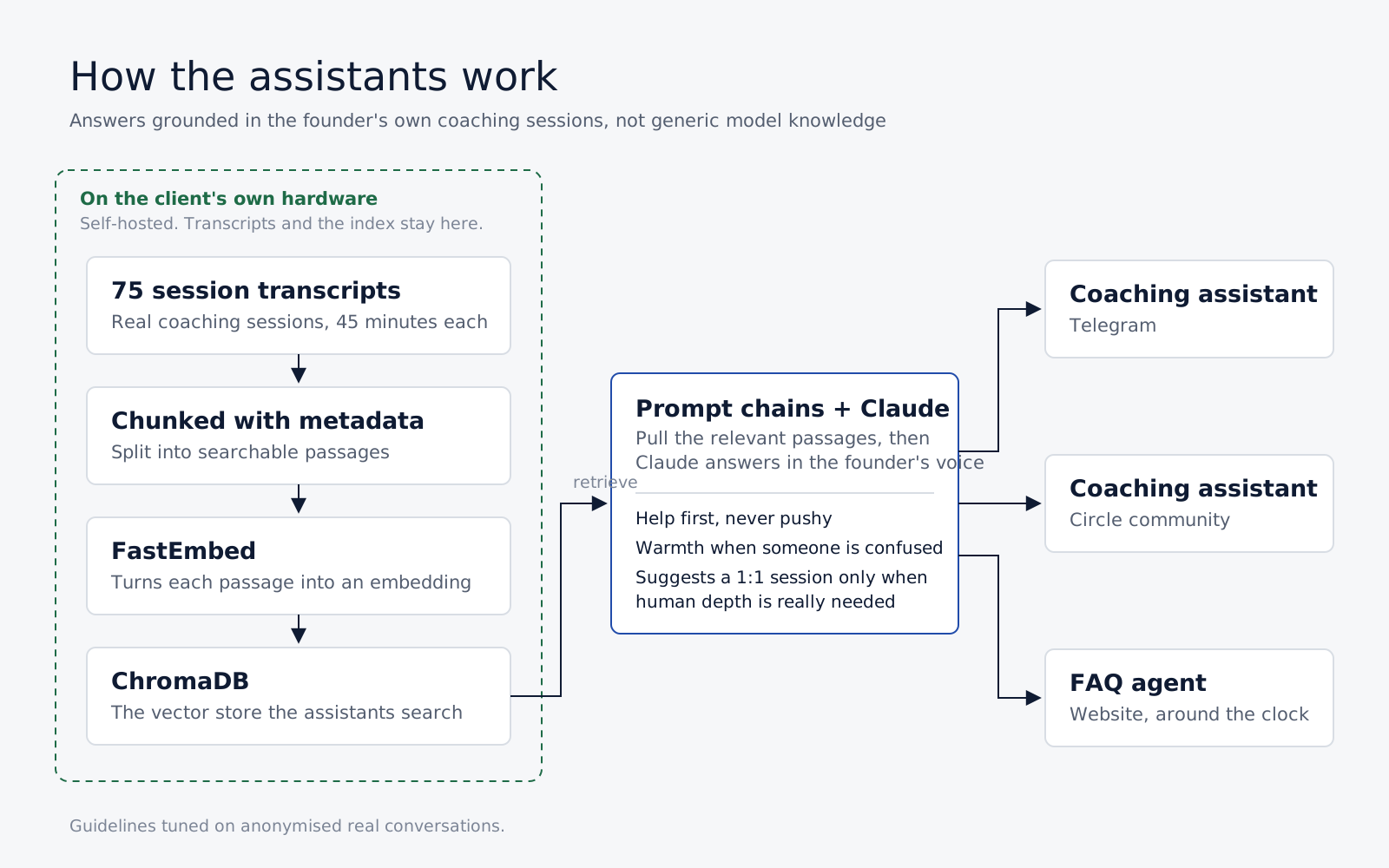
Omnia Consulting (Freelance), 2026
Production AI Agent Systems
Three deployed AI agents: Claude-powered, grounded in real coaching sessions, running 24/7
- Production AI agents deployed
- 3
- Production AI agents deployed
- Session transcripts indexed (RAG)
- 75
- Session transcripts indexed (RAG)

Omnia Consulting (Freelance), 2025
Coaching Business Automation Suite
Three interconnected Make.com automations — CRM, meeting intelligence, and smart reminders
- Reduction in missed appointments
- 40%
- Reduction in missed appointments
- Admin time saved per month
- 12 hrs
- Admin time saved per month
 Under NDA
ProtoPie, 2025–2026
ProtoPie Connect: AI Enablement Docs for Client Engineering
Enterprise skill.md Authoring for ProtoPie Connect
- Context layers per doc
- 4
- Context layers per doc
- Plugin code in one pass
- 0→✓
- Plugin code in one pass
Research
Questions people ask
Is the mapping session really free?
Yes. One to two hours, no cost, and you keep the map and the list of opportunities whatever you decide next.
What happens in the mapping session?
We walk through one workflow, or your whole operation, from the first request to the last follow-up. I ask a lot of questions and draw as we go. You leave with the map and a scored list of opportunities.
Do we need to buy new tools?
Usually not. I build on what your team already uses, because adoption dies when the fix lives somewhere new.
Where does our data go?
Where it needs to, and no further. We decide that up front. Where material is sensitive, I've kept an assistant's knowledge base on the client's own hardware and sent the AI model only what each answer needs.
What if it doesn't work?
We decide what working means before anything is built, then measure it. If the numbers don't justify continuing, I'll say so. I've recommended retiring a product I owned when 30 days of adoption data didn't support it.
Can our team run it without you?
That's the goal. Every engagement ends with documented systems and operating procedures, written for the people who'll own it.
Are you an engineer?
I'm a builder and embedded consultant with a product design background. I build with automation platforms, AI APIs, and Python scripts. For production engineering, I work alongside your engineers rather than replacing them.
Are you looking for a role or a project?
Both. I'm open to full-time AI enablement and forward-deployed roles, and to select projects with teams that want the work to stick.
Bring one workflow. Leave with a map of what to fix.
The mapping session is free, and one to two hours is enough to see where automation and AI would help most. Email me to set it up.